
Genesis...
RKM Swami Akhandananda Private ITI came into existence in the year 2024 as a self-financed ITI offering 2 Yr. / 1 Yr. skills-basedIndustrial Training that empowers students for better futures with greater freedom. The training program inspires to excel in life with self confidence by overcoming challenges and responsibility improving performance. The three tier hierarchical structures based technical education system as followed in India always provides options for students to choose a pathway based on their academic background and career goals. ITI level stands on level 3 below polytechnic level provides students with practical industrial skills and knowledge in a particular trade like electrician, fitter, food processing or mechanical maintenance of agricultural equipment etc. The training program is articulated with integrating proper entrepreneurship training for skill development to succeed in the highly competitive work environment.
Legacy...
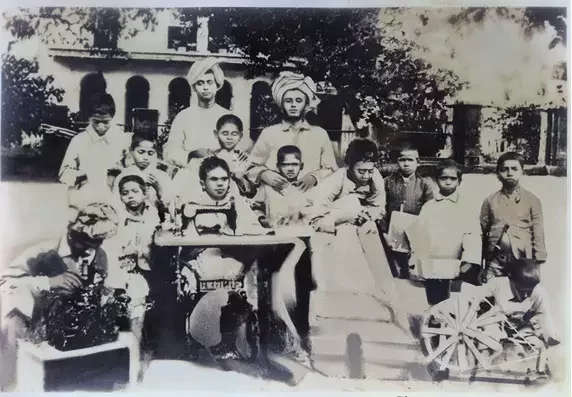
It all started with the famine relief work in Mahula; a village situated about twenty miles away from Berhampore, in the district of Murshidabad of West Bengal in 1897 and to take steps to eradicate the distress and misery of the masses by Swami Akhandananda (Pre monastic name Gangadhar Ghatak); direct disciple of Sri Ramakrishna. Swami Akhandananda then set up Ramakrishna Ashrama in the area in 1898; the first branch center of The Ramakrishna Mission (RKM). The ashram was shifted to the present address at Sargachi in March 1913; 15 years later. Realising the importance of self development Akhandanada Ji Maharaj in the Ashrama initiated to run a vocational school, teaching weaving, sewing, carpentry, and sericulture in 1900 with a belief in his own word “I do not covet earthly kingdom, or heaven, or even salvation. The only thing I desire is the removal of the miseries of the afflicted”. It was a movement to alleviate the poverty and increasing the livelihood of the local people standing on their own feet having earning potential. The Ashrama gradually became a unique blend of imparting quality education, spiritual uplift, and culture where every corner is blessed with Sri Ramakrishna, Ma Sarada, Swami Vivekananda and Swami Akhandananda. The Ashrama complex is surrounded by lush greenery that creates a tranquil environment perfect for introspection and education. It is simply a legacy.
“These are His manifold forms before thee,
Rejecting them, where seekest thou for God?
Who loves all beings without distinction,
He is indeed worshipping the best his God."
Swami Akhandananda was the living manifestation of Swami Vivekananda's new-age mantra of 'Shivajnane jivaseva' (worshipping all living creatures as Shiva). He acknowledged Swamiji, his beloved guru brother, as his guiding star from the core of his heart after their very first meeting. When Swamiji first learnt about 'Shivajnane jivaseva' from Shri Ramakrishna Paramhansa, he decided to reap the seed of selfless service among others. Swami Akhandananda, stirred with the pain of his countrymen, transformed this seed into the plant of selfless service. His primary inspiration for selfless service, or seva dharma, was Sri Zandu Bhatt, the legendary Ayurvedic physician from Jamnagar. Later, Swami Vivekananda motivated him to selflessly serve the people. Swamiji mentioned in his letter that the poor, illiterate, and the unenlightened people should be worshipped, and rendering selfless service for them would be the actual dharma. Swamiji's inspiration unleashed a new horizon in Swami Akhandananda's life. He decided to start his 'seva yajna' at Sargachi.
The sacred land of Sargachi was situated at the bank of the Holy Ganges, which later turned into the Seva Tirtha. Swami Akhandananda provided shelter to the orphans, served them, and arranged for their education. He started a night school at Sargachi along with the day school. He also took concrete steps to make those boys self-reliant. Swamiji always emphasised the self-reliance of people apart from formal education. With the help of experienced players, he made arrangements to teach stick game and exercise to the village youth and poor children, along with wrestling. Swami Akhandananda introduced sericulture and carpentry in the ashram. The wooden handicrafts made by the residents of the ashrama were sold in the exhibitions, and the money collected from the same was used for the service of mankind. A charitable dispensary was also established in the ashram. Even before the advent of Gandhi in Indian politics, he introduced a spinning wheel for cutting cotton and making clothes in the ashram. He, in fact, wove a towel with the spinning wheel. He wanted to make poor Indians self-reliant so that they could make their own clothes. He appointed various carpenters and weavers in the ashram. Vocational education was also introduced to enable poor children to secure their livelihood in the future. Along with this, the Veda recitation, worship, and prayer continued.
Swami Akhandananda focused on both materialistic progress and spiritual enlightenment in the ashram. Swamiji reminded his beloved guru brother about his Guru’s teaching that “an empty stomach is no good for religion.” The heart-warming efforts of this great monk to enable the poor rural people to become self-reliant are a role model for our present generation. He found the path of salvation through selfless service. While purchasing the land of the ashram, Swami Akhandananda had a vivid dream of Swamiji, who instructed him to purchase 50 bighas of land. He also assured that a large institution would be established at Sargachi in the future.
We all need to come forward for the prosperity and growth of Sargachi for its uninterrupted service to humanity. We pray to Swamiji and Swami Akhandanandaji to bestow their blessings on us.
“Thou reaped at Sargachi the seeds of charity.
Thou taught us the mantra of humanity.”