
Ramakrishna Mission Ashrama, Sargachi
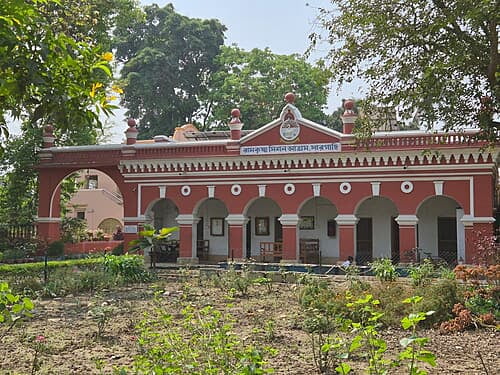
Ramakrishna Mission Ashrama, Sargachi, the first branch center of Ramakrishna Mission with its present Headquarters at Belur Math was founded by Swami Akhandanandaji Maharaj, a direct disciple of Sri Ramakrishna in 1897. Imbibed with the ideal- “Service to man is service to god” as propounded by Swami Vivekananda, the high-souled and compassionate Swami Akhandananda came forward to rescue the famine-stricken villagers of Murshidabad on 15th May, 1897 by distributing rice at Mahula, the birth place of this Ashrama, about 3 Kilometers southwest of Sargachi. The present site of Sargachi was taken over in March 1913 after 2 years of its existence at Mahula and 14 years at Shibnagar. It has grown into a huge complex with varied activities. It has about 33 acres of land dotted with flower gardens, agricultural and vegetable gardens, green field and mango groves. The Ashrama has engaged itself in disaster-management, educational and healthcare activities of the local people since its inception.
Swami Akhandanandaji Maharaj, by 40 years of his austerity and extensive service activities turned this unknown, remote village of Sargachi into a huge complex with vairied philanthropic activities. This Ashrama has been rendering its humble services to the humanity in all the above-noted sphere of activities uninterruptedly for more than one hundred years giving solace and peace to thousand of suffering people in these rural areas. The multifarious educational and cultural activities of the Sargachi center of the Ramakrishna Mission have behind them the inspiration of years of this new form of tapasya of its founder Swami Akhandanandaji Maharaj.
The Ramakrishna Mission Ashrama at Sargachi holds a unique and sacred place in the history of the Ramakrishna Order. Born out of deep compassion for the suffering masses, it stands as the site of the very first formal relief operation conducted by the Ramakrishna Mission.
Timeline Summary
May 1897: Swami Akhandananda initiates the first RKM famine relief work.
Aug 1897: Orphanage founded in a thatched hut in Mahula village.
Oct 1898: Relocated to a two-story house on Sargachi Krishnanagar Road.
1900: The first Lower Primary and Industrial Schools are established.
Mar 1913: The Ashrama moves to its permanent 50-bigha campus in Bhabta.
1929: The two-story Temple of Sri Ramakrishna is completed.
1933: "Binod Kutir" and the Charitable Dispensary buildings are constructed.
Feb 1937: Passing of the founder, Swami Akhandananda.
1958–1963: Major campus expansion including the Higher Secondary School, Basic Training Institute, and hostels.
The Genesis: Famine Relief and the First Orphanage (1897)
The story of the Ashrama begins in 1897 when Swami Akhandananda, a direct monastic disciple of Sri Ramakrishna, was traveling toward Murshidabad from Alambazar Math. Upon witnessing the horrific devastation of a local famine, his heart melted for the afflicted, and he abandoned his journey to serve them. With the encouragement of Swami Vivekananda—who sent Rs. 150 and two assistants, Swami Nityananda and Swami Sureshwarananda—Swami Akhandananda officially began famine relief work on May 15, 1897.
During this relief work, circumstances compelled Swami Akhandananda to take full responsibility for two orphan boys, Nutubihari Das and Pathakari (Virbhadra). This compassionate act sparked the resolve to establish an orphanage. On August 31, 1897, the Ashrama officially took root in a humble thatched hut belonging to Mrityunjay Bhattacharya in Kedarmathi, Mahula village.
Relocations and Finding a Permanent Home (1898–1913)
As the orphanage grew, it required more space. The Ashrama went through key geographical transitions before settling into its current expansive campus:
October 1898: The Ashrama was moved to a two-story kachari house owned by Madhusundari Barmani, located beside the Sargachi Krishnanagar Road (current NH-34). The Ashrama operated from this location for about 14 years.
March 1913: Through the dedicated efforts of Rai Bahadur Vaikunthanath Sen, a prominent lawyer from Baharampur, a 50-bigha plot of land in Bhabta was secured from local landlords Haji Muharram Ali and Haji Abdul Aziz. Moving to its own land accelerated the Ashrama's progress. Over time, the campus expanded to over 100 bighas of land.
The Building of the Ashrama: Temples and Infrastructure
With a permanent location established, the Ashrama began constructing the vital infrastructure needed to serve the community's spiritual, educational, and medical needs.
1918: The first major brick-built structure was completed, housing the library, the orphanage, and an administrative office.
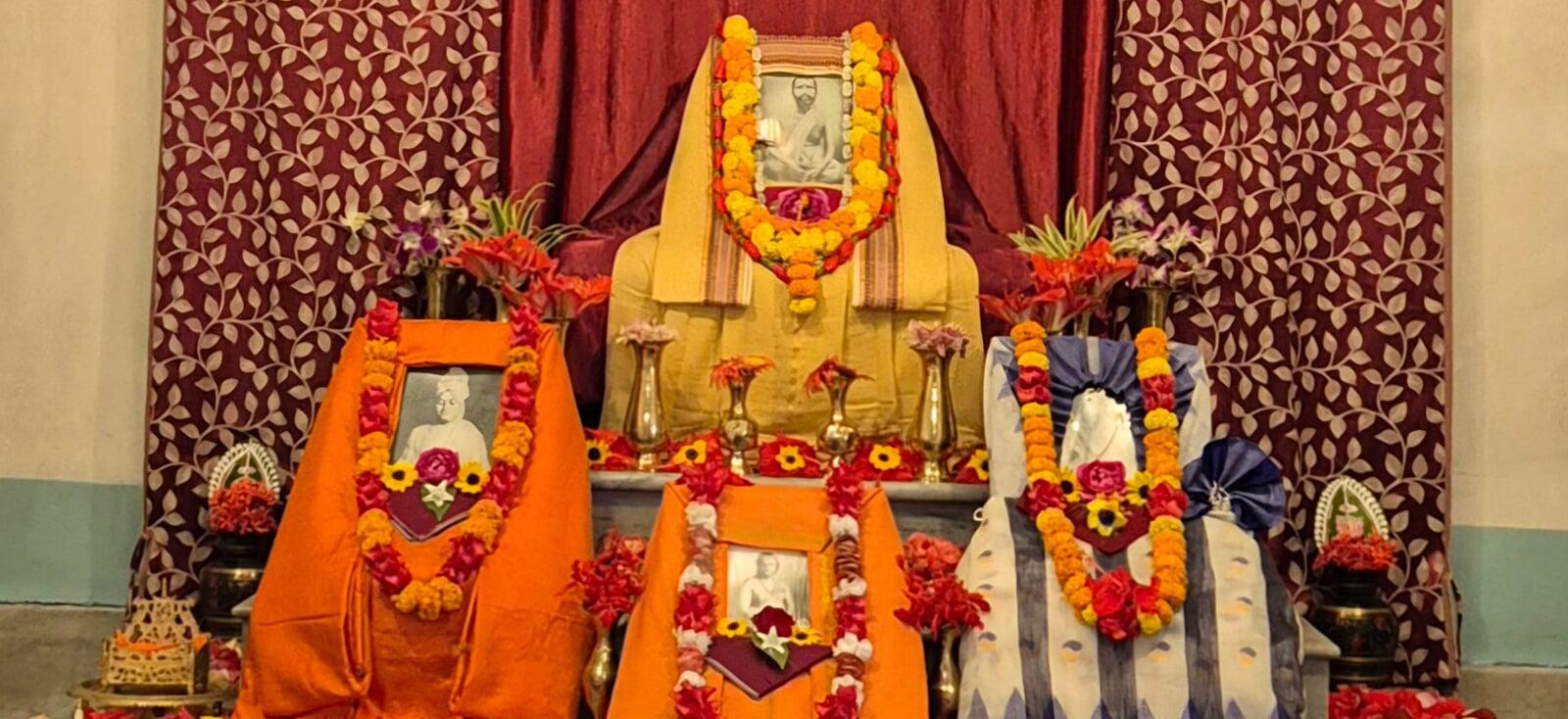
1929: The spiritual heart of the campus, the two-story Temple of Sri Ramakrishna, was completed. A marble altar was installed on the upper floor featuring portraits of Sri Ramakrishna, Holy Mother Sri Sarada Devi, and Swami Vivekananda, while the ground floor was utilized as a storeroom and living quarters for workers.
1933: To accommodate the growing number of monastics and guests, a single-story permanent building named "Binod Kutir" was built with financial assistance from Binodbihari De of Kolkata. (This building was later expanded into a two-story structure in 1953 ). In the same year, the generous Haji Muhammad Yusuf of Beldanga funded the construction of a permanent building for the Ashrama's Charitable Dispensary.
1967: To further ease the accommodation of visiting devotees, a dedicated Guest House was constructed through the efforts of Dr. Satyendranath Sen, the then Vice-Chancellor of Calcutta University.
Education Expansion (1950s-1960s)
Following India's independence, the Ashrama saw a massive boom in its educational infrastructure, heavily supported by government and public funds:
1953: Construction of the Middle English School building.
1956: Construction of the Social Education Center (for the night school).
1957: Construction of a dedicated Primary School building.
1958–1963: A period of rapid development saw the construction of the Junior Basic Training Institute, the Higher Secondary School, two Basic Schools, two student hostels, and several staff quarters for teachers.